
Structural Design of Powerhouses for Hydropower Projects
Honey Mehra1*
1 Senior Technical Principal, SMEC, India.
*Corresponding Author: Honey Mehra, Senior Technical Principal, SMEC, India, TEL: +91 919818093546 ; FAX: +91 919818093546;E-mail:honey.mehra@smec.com
Citation: Honey Mehra (2018) Structural Design of Powerhouses for Hydropower Projects. SciEnvironm 1:117.
Copyright:© 2018 Honey Mehra, et al. This is an open-access article distributed under the terms of the Creative Commons Attribution License, which permits unrestricted use, distribution, and reproduction in any medium, provided the original author and source are credited
Received date: June 12, 2018; Accepted date: July 17, 2018; Published date: July 21, 2018.
Abstract
Powerhouse for a hydropower project is defined as a building which houses the turbine, crane, the rotor assembly area, cable trays and other ancillary mechanical and electrical systems. Different structural systems for the superstructure are proposed in powerhouses already constructed or under construction in various parts of the world combining both RCC and structural steel elements. These systems are as enumerated below:
a) RCC superstructure with RCC girder for EOT crane(s) and trussed steel roof.
b) RCC superstructure with RCC girder for EOT crane(s) and portal steel roof.
c) RCC superstructure with steel girder for EOT crane(S) and trussed steel roof.
d) Steel superstructure with steel girder for EOT crane(s) and portal steel roof.
The substructure of the powerhouse consists of the scroll case and draft tube which varies with the type of turbine proposed viz
Pelton, Francis (both vertical and horizontal), Kaplan etc. The scroll case also can be only concrete or steel lining embedded in concrete. The design of the superstructure is basically a 3 dimensional frame design done using various state of art software’s like STAAD PRO. Here the design is checked for serviceability conditions like deflection and crack width as well as for structural adequacy. The columns, beams and the girders that form part of the 3D frame are provided with adequate size to meet the serviceability criteria and adequate reinforcement to take care of different compressive, bending and tensile stresses. The design of the substructure, on the other hand, revolves around two components the scroll case and draft tube. The scroll case is essentially a tube carrying water with changing dimensions as it empties into the draft tube. As such it can be designed by taking cross-sections at regular intervals. For steel scroll cases the design of the steel part lies with the electromechanical vendor. However the concrete embedment around the steel casing is done by civil team. The civil design majorly depends on the pressure to be taken by the steel part and the concrete embedment. An initial gap between the two parts is kept so that the head on the scroll case is shared. The draft tube is like a box with increasing height as it goes and meets the tail race. Generally, it is an RCC structure and is designed like a box with intermediate piers.
Introduction
Structural design of powerhouses for hydropower projects is a fascinating topic which has been discussed in various forums. Its uniqueness lies in the various types of powerhouses built around the world. Structural Steel and reinforced concrete have been extensively used for taking the loads of EOT cranes, generator, draft tube liner, scroll case, gantry gates/monorail hoists for lifting stoplogs. The design of powerhouse has been traditionally divided into two parts viz Superstructure design and Substructure design. Superstructure consists of columns and beams with trusses/portals as the roof. Substructure acts as the foundation of the superstructure and consists of a generator barrel, scroll case and the draft tube. Figures 1 and Exhibit 1 respectively shows the typical X-section of a powerhouse and the photo of constructed powerhouse.
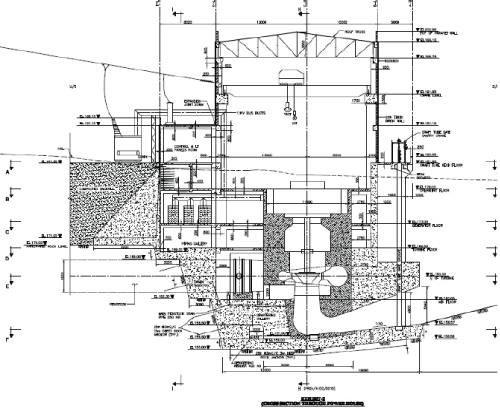
Figure 1: Typical X-Section of Powerhouse.

Exhibit 1: Photo of Powerhouse from Inside.
Powerhouses are generally of 4 types. Each type of powerhouse is described in detail in the subsequent discussion :
a) RCC superstructure with RCC girder for EOT crane(s)and trussed steel roof
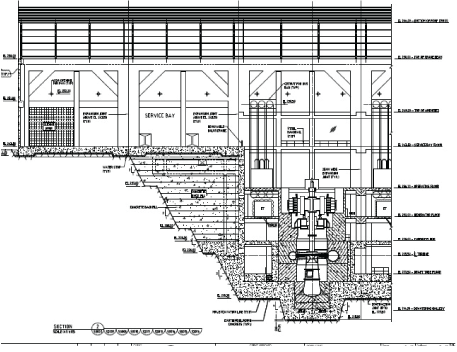

b) RCC superstructure with RCC girder for EOT crane(s) and portal steel roof
Here the framed structure and the crane girder remain same as (a) above. However, steel portals replace the trusses. The purlin system to provide support the roofing system remain the same. This concept is popular with French designers and a number of powerhouses have been built in Europe with this concept. In India Kol Dam Powerhouse (800MW), H.P India is one good example. Figure 4.

c) RCC superstructure with steel girder for EOT crane(S) and trussed steel roof
Here the framing system remains the same as (a) above. However, the crane girder is made of structural steel. The steel crane girder is simply supported on the columns with translational flexibility at one end to take care of temperature effects. The roofing system is also made of structural steel. An example of such type of powerhouse is Maheshwar H.E Project (400 MW), M.P, India. Figure 5.

d) Steel superstructure with steel girder for EOT crane(s) and portal steel roof
This type of powerhouse has steel columns and beams on the same pattern as cement plants and industrial sheds. This is preferred when the powerhouse has to be constructed very fast. Typically, I girders/Universal beams make up the numerous beams and columns making up the gigantic frame [2]. The Crane girder is also made of steel. The roof is in the shape of a portal which is also made of I girders. An example of such type of powerhouse is MGHE Tail Race H.E project (22 MW), Karnataka, India. Figure 6.
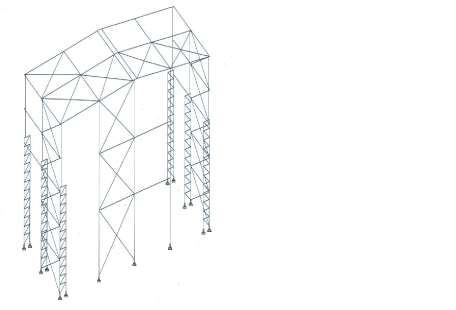
Figure 6: Steel Superstructure of Type (d).
Design and Analysis
The design and analysis of a powerhouse is a complex topic and has evolved over the last 100 years. The Americans (Tenesee Valley Authority), The Russians, The French (Electricite De France – CIH), The Australians (Snowy Montains Engineering Company), the Canadians (SNC – Lavalin) and recently the Chinese have been pioneer in this challenging field [3]. In India Central Water Commission and National Hydroelectric Power Corporation have designed various powerhouses in India as well as neighbouring countries like Bhutan, Nepal, Sri Lanka and Laos. Typical examples of hydro powerhouses built over the world are the Fontana Powerhouse (USA), Grand Maison dam (France), Three Gorges project (China), Itapu Dam (Brazil).
Typically, the design of a powerhouse is done in two parts – Superstructure and Substructure.
Superstructure – Since the superstructure is a framed structure consisting of beams, columns and the roof (portal or truss) it is analyzed with software’s like STAAD Pro, GT Strudl etc. The major conditions which govern the analysis are:
1) Differential Deflection at the Crane Beam Level – This depends on the manufacturer of the crane. Since the crane has to rest on the U/S and D/S Columns it can only allow a limited differential deflection depending upon the tolerance in crane span. This is a very difficult criteria to achieve since the allowable deflection varies from 5 to 10 mm. Hence various procedures are adopted to achieve this condition. The columns and beams can be strengthened but that has limited effect in reducing the deflections. A common way adopted is to use the roofing system as a strut between the columns. For this the portal or the truss to be used as the roof is hinged at both end to the columns, which, in a way means that the lateral force is transferred to the portal/truss [4]. Though adoption of this system means heavy members for the roof, yet it is an efficient way to control the differential deflections.
2) Total Deflection at the Roof – This is governed by national building codes specific to each country and is a function of the height of the structure. Typically, in India a deflection of 0.002h is allowed.
The dimensions of the structural elements depend upon the allowable stresses as per the country specific code. Various forces like dead load, live load (including crane load), seismic load, wind load is taken for the analysis of the superstructure. Once a structure is analyzed the various structural elements are designed. For RCC elements reinforcement is found out and for the steel structures, their adequacy to withstand the loads is checked as per the codes.
Substructure
The substructure not only acts as a foundation of the superstructure but also consists of various elements whose design is complex. The main components of the substructure are the scroll case, draft tube and the barrel.
Scroll Case
The scroll case is essentially a tube carrying water with changing dimensions as it empties into the draft tube. Generally, two types of scroll cases are given for low heads concrete scroll cases are adopted. However, construction of concrete scroll cases is difficult as shuttering required to achieve the spiral section demands a great amount of skill. Typically for Maheshwar H.E project in India which has one of the largest concrete scroll cases (max height = 9.6m) a scaled down model was constructed near the project so as to help the skilled workers to understand how to make the shuttering at the powerhouse site. Generally, for medium head and high head plants steel, scroll cases are given which are subsequently embedded in concrete. As such concrete scroll cases can be designed by taking cross-sections at regular intervals. For steel scroll cases, the design of the steel part lies with the electromechanical vendor. However, the concrete embedment around the steel casing is done by civil team. The civil design majorly depends on the pressure to be taken by the steel part and the concrete embedment.
An initial gap between the two parts is kept so that the pressure on the scroll case is shared (The steel part is allowed to expand for the designed pressure filling the gap between the steel and concrete part).
Draft tube
Draft tube is essentially a tubular structure starting at the end of the scroll case. Initially it has elliptical section which gradually transforms into a circular section. The draft tube at its lower end then bifurcates into two or three parts depending upon the number of intermediate piers and size of individual unit of powerhouse. At the start, draft tube is just a hole in mass concrete and needs only skin reinforcement around the opening but after bifurcation it becomes twin cell box or three cell box depending upon the number of intermediate piers. It is analyzed using state of the art software’s for primarily self-weight and water load. In most cases, it also supports the stop log hoisting arrangement at the end of the draft tube. Adequate reinforcement is provided to resist these forces.
Generator Barrel
Generator barrel is a hollow cylinder of increasing thickness as we go down the powerhouse. The barrel supports the load of the stator and rotor as well as the floor load coming on the generator floor. This hollow cylinder is idealized as plate/solid elements and stresses/forces are found out using state of the art FEA software’s. Based upon these stresses/forces adequate reinforcement is provided in the barrel.
Results
Powerhouse can be planned in different ways according to the site conditions, material availability, economy and pace of construction.
Depending on the type adopted, the powerhouses are designed using state of the art software’s like ANSYS, NISA, STAAD Pro etc. The underlying basis of the design is that they should be able to withstand the forces incident on them during their design life. Powerhouses can be defined as buildings which civil engineers design for electrical engineers. Hence it is an interdisciplinary subject where the functional aspects are looked after the electrical engineers and the design aspects by civil engineers. As new techniques evolve in construction, there will be new variants to the four systems highlighted in the article and to design those new analytical systems in the form of software’s will be developed.
Acknowledgement
I would like to acknowledge the contribution of Mr S.M.A Raza, Mr S.P Sobti and Frank Borg who had a significant contribution to my understanding of the powerhouse both from functional and design aspect.
I would also like to thank my family for their patience and encouragement.
References
- Emil Mosonyi Water Power Development Vol 1 and 2 High Head and Low Head Power Plants.
- P.S Nigam – Handbook of Hydroelectric Engineering.
- Tennesee Valley Authority – The Fontana project – A comprehensive report on the planning, design, construction and initial operation pf Fontana project, Technical report.
- CBIP,India – Design and Construction features of selected hydropower plants in India.